
Modern shopping malls have changed their primary function. Today, they are not just places where people shop; they have turned into experiences, featuring various restaurants, entertainment zones, events, promotions, services, and numerous brands that compete for customers.
In such conditions, digital signage for shopping malls becomes an integral part of communication and customer experience improvement. With the use of digital advertising screens, interactive directories, LED video walls, and wayfinding displays, it is possible to communicate information in a fast, interactive and updated manner instead of using static and slow-changing traditional signage.
However, as there are multiple display types and solutions, it is quite difficult to select the most suitable digital signage option.
This article describes shopping mall digital signage features, its application options, possible displays, and some aspects of solution choice to consider before investment.
What Is Digital Signage for Shopping Malls?
Digital signage is electronic displays designed to show various information such as advertising, promotions, directions, announcements, event information, brand campaigns, and so on.
In a shopping mall, these displays can be mounted in different places depending on their purpose.
For instance:
- A large LED video wall can be mounted in the mall atrium for advertising and brand campaign purposes;
- Digital directories will allow the visitors to find shops, restaurants, and facilities of the mall;
- Interactive touchscreens will let the customers search for a certain shop or place;
- Digital displays can be mounted near escalators to show offers and coming events;
- Outdoor displays will communicate the needed information to customers when they still do not enter the mall;
- Digital menu boards can be used in food courts and restaurants.
What is important here is that there is no single type of digital signage for all shopping mall locations. It should be chosen according to the place of installation and purpose.
Why Do Shopping Malls Need Digital Signage?
Despite that printed signage is still quite useful for certain purposes, it is not always a perfect choice. Changing a printed advertisement or directory may require some effort, but remote updating is possible with digital content.
It may turn out to be a great advantage for mall managers.
- Promotion of Stores and Special Offers
Retailers can use digital signage to promote:
- Seasonal discounts
- Launching of new products
- Special offers
- Campaigns of brands
- Flash promotions
- Opening of new stores
Instead of displaying just one static message during the whole day, digital screens can display multiple campaigns at predetermined times.
- Helping People Navigate Around Malls
Big shopping centers can be hard to navigate for visitors who visit them for the first time.
Digital directories and interactive wayfinding displays can help people find:
- Stores
- Dining halls
- Cinemas
- Parking places
- Toilets
- Prayer rooms
- Desks of customer service
- Entertainment places
A good design of the digital wayfinding system can eliminate the problems.
- More Engaging Advertising
Digital screens can display videos, animations, pictures of products, promotional material, etc.
Advertisers will have more possibilities of creativity compared to the poster format.
In the case of high traffic areas like entrances, atriums, food courts, big digital screens will serve as an important advertising space.
- Displaying of Important Information
It is not only advertising that can be displayed by digital screens.
The management of the mall can use digital screens to display:
- Announcements of events
- Information about emergency situations
- Notifications to the public
- Working hours of the mall
- Information on parking
- Informations for customers
- Seasonal greetings
And much more.
Where Can Digital Signage Be Used in a Shopping Mall?
Identifying areas of need is one of the initial steps in any digital signage project.
Different needs mean different solutions.
Entrances
These displays represent the first digital experience for visitors.
Commercial displays or LED screens may be used to welcome visitors, advertise events or campaigns, promote certain brands, etc.
Outdoor entrance displays must be designed to operate under certain weather conditions.
Atriums and Central Areas
Atriums represent one of the most visible parts of the mall.
The following digital screens can be used here:
- For brand advertising
- For product launches
- For events
- For seasonal campaigns
- For entertainment content
Since this kind of digital display can be really large, screen size and viewing distance should be taken into account in advance.
Digital Mall Directories
With the help of digital directories, it is possible to replace or enrich traditional directories in a mall.
Visitors will have an opportunity to search for the required store by name or type and see its location.
The interactive directory will also give an opportunity to obtain the following information:
- Information about the store
- Floor number
- Opening hours
- Offers
- Nearby facilities
- Navigation instructions
- Interactive directories are especially helpful for large malls.
Corridors and Walkways
Digital displays placed in highly-visited corridors can be used for advertisement and communication inside the mall.
In these places, the size of the display does not have to be really big. Often, in such places, multiple small commercial displays can perform better than one large screen.
Escalator Zones
Escalators represent another zone with repetitive visitor exposure, since visitors usually spend several seconds passing from one floor to another.
Digital displays can be used here to promote:
- Stores
- Restaurants
- Events
- Special offers
Food Courts
Digital displays are especially helpful in food courts.
The following functions can be performed with their help:
- Digital menu boards
- Meal promotions
- Combo offers
- Menu item promotion
- Video advertisements
Digital menu boards will help to update information related to menu and prices easily.
Parking Zones
Digital displays can help visitors even before entering the shopping area.
Screens can provide the following information depending on the specific purpose:
- Parking directions
- Information about the mall
- Promotional messages
- Event information
- Traffic information
Displays to be installed in parking zones should be selected taking into account the lighting and other environmental conditions.
Which Digital Signage Types Are There?
Every mall does not have one universal display for digital signage.
It all depends on the site, viewing distance, type of content, screen size and cost.
Commercial Displays
Commercial displays are popular choices for indoor digital signage.
These devices are made for longer periods of operation compared to regular consumer television sets and come in various sizes.
They might be appropriate for:
- Retail passageways
- Windows
- Info kiosks
- Advertising
- Food courts
- Reception areas
For professional installations in the mall, commercial displays would normally make a better starting point than standard TV sets.
LED Video Walls
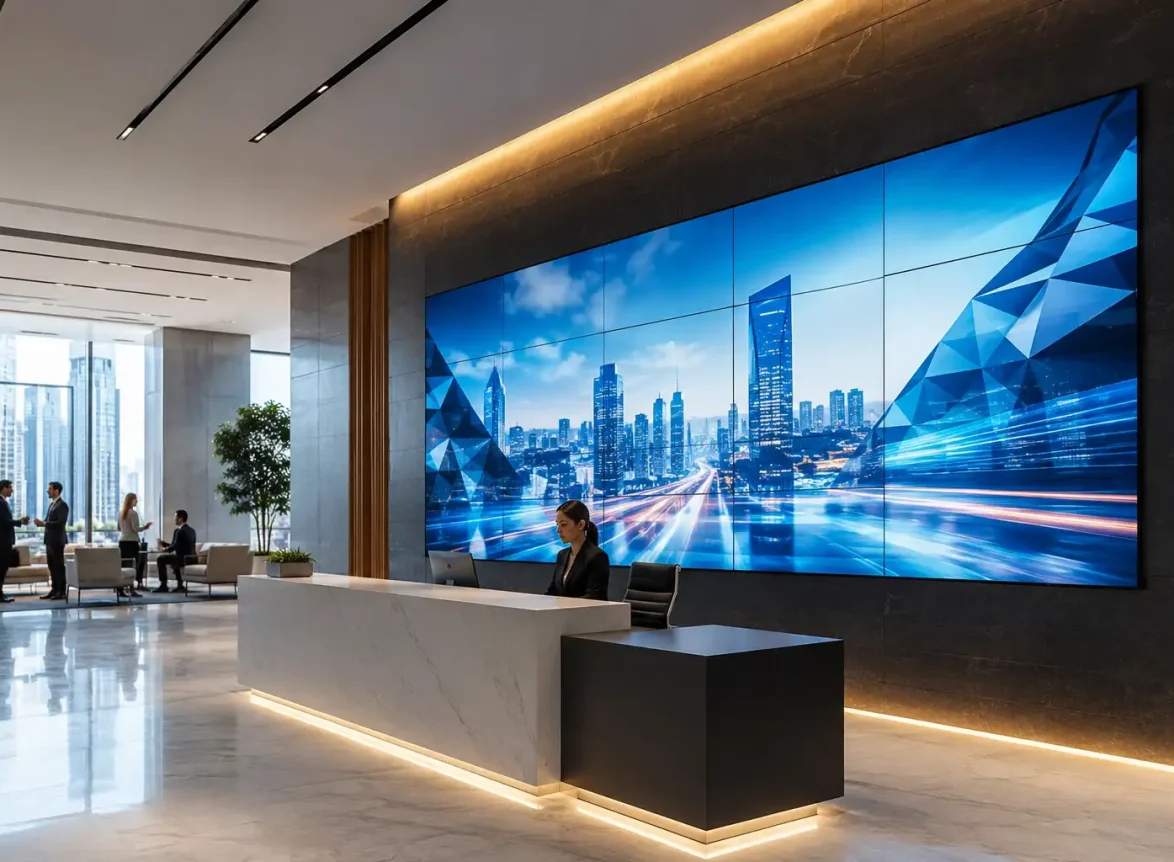
If you need to create a big and impressive visual digital experience, an LED video wall could work.
LED displays could be made in huge formats and are appropriate for projects such as:
- Atriums in the mall
- Big advertisement walls
- Stages at events
- Brand activation
- Entry areas
You need to choose the proper pixel pitch depending on your viewing distance. Your screen may need finer pixel pitch if you need to view it from a short distance compared to the large screen viewed from meters away.
Video Walls
LCD video walls include using commercial displays that create one visual surface from multiple screens.
This type might be helpful if you need a big screen but do not need an LED solution.
LCD video walls are often used for:
- Advertising
- Surveillance
- Info displays
- Control room
- Promotions
Interactive Touch Displays
Interactive touch screens allow interaction with the content.
For the shopping mall, interactive displays could be used for:
- Retail directories
- Interactive maps
- Way-finding
- Promotions
- Visitors info
The user interface needs to be simple and intuitive. If you have a nice touchscreen but visitors cannot easily use it, it will not provide the needed results.
Digital Signage Selection Guide for Your Mall
Selecting a display shouldn’t begin with the size of the screen.
Begin by defining your application.
Consider the following when selecting equipment.
- Where Will the Screen Be Placed?
It will be:
- Indoors?
- Outdoor?
- Near the entrance?
- In the atrium?
- In a corridor?
- In a food court?
- In the parking lot?
The answer to this question defines the type of display you need.
- From How Far Away Will the Visitors See It?
Viewing distance should be one of your main considerations.
A screen placed near the visitors requires different resolution and size compared to a big advertising screen viewed from the other side of the atrium.
- How Much Light Will There Be?
A display placed in the dark corridor does not require the same level of brightness compared to a screen placed beside the glass entrance with strong daylight exposure.
Bright environments require careful consideration of the display brightness.
- For How Many Hours a Day Will the Screen Operate?
Display in shopping malls could work a lot of hours per day.
This is why commercial displays meant for professional use are a better choice than TVs.
- What Kind of Content Will It Show?
Before choosing your display, think about the kind of content you are going to show.
It could be:
- Static images?
- Promotional videos?
- Information?
- Maps?
- Social media content?
- Advertisements?
- Emergency information?
Digital Signage Content Management System (CMS)
Purchasing the screens is just one step in a digital signage project.
Another important aspect is to have a means of managing the content that is displayed.
Digital signage content management system (CMS) gives mall owners or approved users a centralized method of content management.
Depending on the system, the CMS might allow:
- Image and video uploads
- Campaign scheduling
- Managing of multiple screens
- Organization of displays according to location
- Remote content updates
- Scheduling of different content at different times
- Monitoring of connected displays
In case there are dozens or even hundreds of screens in a shopping mall, centralized management might greatly save time.
Think about visiting each screen individually each time promotion is changed. A centralized system makes it feasible.
Digital Signage for Shopping Malls: What About Advertising?
Digital signage is also an effective advertising tool for mall operators.
Not being limited to selling advertising space on banners, it is now possible to schedule digital advertising.
For instance, the following schedule could be created:
- 10:00 AM – Retail Promotion
- 12:00 PM – Restaurant Campaign
- 2:00 PM – Fashion Brand Advertisement
- 5:00 PM – Mall Event Promotion
Exactly the scheduling depends on the mall’s advertising model and the digital signage software being used.
From the standpoint of advertisers, digital signage allows more flexibility as changing of the campaign doesn’t require replacing the printed material.
Digital Signage vs Traditional Signage
Traditional signage also has its role, however, digital signage has many benefits in case of dynamic messaging.
| Traditional Signage | Digital Signage |
| Static content | Dynamic content |
| Physical replacement required | Content can be updated digitally |
| Usually one message | Multiple messages |
| Limited media options | Images, video and animation |
| Manual campaign changes | Scheduled campaigns |
| Difficult to manage at scale | Centralized management possible |
It is not necessary to fully replace all the traditional signs with the help of digital signage. The best practice in most cases is to combine both of them depending on the particular application.
Mistakes to Avoid in Digital Signage for Mall Shopping Centers
To create an efficient digital signage system, it is not enough to buy costly displays.
Here are some mistakes to avoid.
Choosing a Display Solely Based on Its Price
The cheapest display may not be the most appropriate option for mall digital signage.
Think about operating time, brightness, warranty, connectivity, maintenance, and reliability of the display.
Using TVs for Commercial Projects
Conventional consumer TVs may not be designed for professional operation.
When implementing a project for professional digital signage in shopping malls, it is always advisable to use commercial displays.
Not Thinking About Content Management
Installing dozens of displays without a proper content management system may complicate content management.
Plan your software and hardware solutions simultaneously.
Choosing Inadequate Brightness
While looking great in a showcase, a display can behave differently in a mall with its light conditions.
It is always necessary to consider the place of installation of the display.
Neglecting Installation and Maintenance
A digital signage project implies much more than just the display.
Components of a digital signage project may involve:
- Displays
- Systems for mounting
- Media players
- CMS software
- Network
- Cables
- Installation
- Configuration
- Maintenance
Considering these components from the very beginning of planning can help to avoid issues.
How Much Does It Cost?
There is no set price for a small digital signage system.
The total price is influenced by such factors as:
- Number of displays
- Size of displays
- Type of displays
- LED pixel pitch
- Outdoor or indoor installation
- Touchscreen requirement
- CMS software
- Media players
- Mounting system
- Cabling
- Installation
- Creation of content
- Maintenance and support
A small digital signage system with commercial displays will have another budget from a mall-wide system with LED video walls, interactive directories, and content management system.
That is why it is always better to ask for a proposal according to your needs instead of making comparisons between prices of displays.
A Basic List of Information Prior to Buying Digital Signage for Your Shopping Center
Prior to contacting the digital signage provider, you should prepare the following information:
- Number of required screens
- Screen placements
- Indoor/Outdoor needs
- Size estimates for the screens
- Viewing distance
- Hours of operation
- Content type
- Need for interaction/non-interaction
- Requirements for CMS
- Requirements for network availability
- Installation requirements
- Maintenance and support requirements
With this information prepared, it will be easier for the AV provider to recommend a solution.
The Importance of Professional Planning of Digital Signage
While a shopping center can offer hundreds of possible locations for digital signage, not all of them will need the same technology solutions.
The appropriate system will take into account the whole picture from screen choice and placement to content management, networking, installation, and maintenance.
For example, while a digital directory will need an interactive screen and wayfinding software, the digital advertisement wall in an atrium might need a big LED display. The food court will likely suit better commercial menu displays.
This is why professional site assessment is needed prior to buying equipment.
Conclusion
Digital signage in shopping malls is more than just installing screens around the building.
If designed correctly, digital signage will be able to help people navigate the shopping center, create additional advertising possibilities, increase the attractiveness of retailers, transmit important information, and improve the overall visitor experience of the shopping center.
It all comes down to the shopping mall’s infrastructure, target audience, lighting, viewing distance, content, and financial resources.
So, when you decide to install digital signage in your shopping mall, first, you have to define where exactly it should be applied and for what purpose. After that, you will know what type of commercial displays, LED video walls, interactive screens, media players, CMS software, and installation you should pick up.
In the case of the UAE and GCC shopping malls, one more step is recommended – you should do a professional AV site survey and understand what display technology, brightness, screen sizes, mounting and content management you need.


Leave a Comment
Your email address will not be published. Required fields are marked *